
Happy Thursday, friends!
You guys, I hope this is you right now…

…because we are going to chat about books for the SECOND day in a row.
Now, stop, stop, STOP if you’re not a reader. Today’s post is nothing like YESTERDAY’S (which was FABULOUS by the way!). I think you can glean something from this post without ever reading this book (but you should totally read it if you’re a reader!).
Kind of sort of accidentally, every year, I read a handful of non-fiction books and one will just jump out and SCREAM AT ME and become a book that in a lot of ways changes my life.
For example, last year, I read DIE WITH ZERO. This one rocked both my world AND my husband’s. Andrew and I still give this book away to anyone we think will read it. It has truly changed the way we live.
A few months ago, I was here on Nantucket and popped inside one of the bookstores and saw this book…
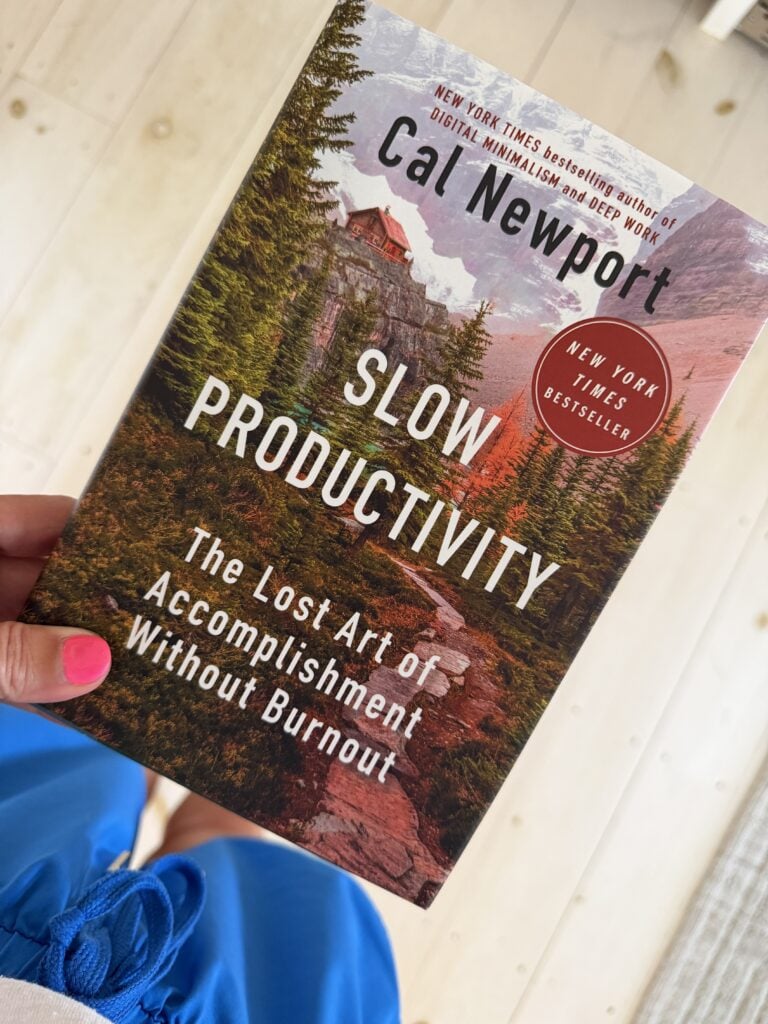
…SLOW PRODUCTIVITY by Cal Newport.
I had heard of this author and heard his work mentioned before, but I had never read anything by him. I bought the book, took it back to Texas with me, and it sat next to my reading chair in McKinney…but for some reason, I never picked it up. In May, I brought it back with me to Nantucket this summer determined to read it and HOLY COW, I truly don’t think I’ve ever annotated a book more.
And as soon as I was finished, I started reading it all over again.
When you look through my copy, there is hardly a page where I haven’t underlined a passage and/or made a note in the margin. This book has already been so impactful for me that I thought it needed its own dedicated post before I mention it in this month’s book review.
I don’t want to give away too many of the insights and strategies from this book (as I would love for you to support the author and read it too!), but let’s be real, there is no way I could begin to do it justice.
Instead of recapping the entire book, I’m going to share 10 OF MY FAVORITE TAKEAWAYS and how I’ve implemented them in my daily routine to *hopefully* inspire and encourage you to read the book too.
As a small business owner, it’s easier for me to change workflow, strategies, “ways” of doing my job because I’m the boss. I know many of you are not the boss, and the author does a really great job of addressing these same strategies when you work in environments you have much less control over (teaching, nursing, etc). Needless to say, you don’t have to be self-employed to gain inspiration here. I even think if you’re retired you could read this book and reconsider your schedule/commitments/time restraints/overall sense of wellbeing around how you spend your time and if/how you could make tweaks.
I’ve already bought the book for one friend to read as well. I’m telling you, it’s one I will be sharing again and again.
Alrighty, here are 10 OF MY FAVORITE TAKEAWAYS (I could have done 100!). I am just going to give some quick notes below. In the book, he goes into great detail about each one, why it’s valuable (or not valuable), strategies to implement these things, real life examples of what happens when we do/don’t, and how it can positively affect us.
#1: GOOD WORK DOES NOT REQUIRE BUSYNESS
I know it’s the American culture to “be busy”, but I have to let go of the notion that “busyness equals good work”. I actually don’t love the word “busy” and have been trying to replace it with the word “productive” especially when talking to my kids. When we are chatting about our days, I have really tried to stop saying “I was so busy” and change it to “I was so productive” because (thanks to all of these podcasts and books that I keep consuming about living in the moment), I don’t want my kids to think I just rush around “busy” all day long. I want them to (hopefully) understand I used my time to be productive. My personality is one of “go, go, go”, and I’m quick to fill any and all free time with “more things”. I am trying to remind myself that producing “good work” in anything I do (my actual work, church stuff, stuff with my kids’ schools, etc) doesn’t have to “be busy” in order to be effective.
#2: DON’T CONFUSE ACTIVITY AS “EFFORT”
I can have a really really FULL day at my desk and yet not produce anything that really was valuable. I can apply the same principle to working out. I can be “really active at the gym” but not have given my best effort during that hour and thus, not produced any good results.
#3: TECHNOLOGY NOT ONLY DISTRACTS, BUT IT MAKES US FEEL OVERLOADED
I know we know this, but do we REALLY KNOW THIS? I always always feel better when I’ve walked away from technology and rarely (if ever) do I feel better when I’ve spent a lot of time on technology.
#4: DO FEWER THINGS FOR BETTER RESULTS
Less is more, less is more, less is more. I am chanting this to myself often because I am not one who practices this well at all. Newport gives so many great examples of really accomplished people (artists, athletes, entertainers, scientists) who did much less to achieve some of our most remarkable accomplishments.
#5: SO MUCH OF WHAT WE DO IS SELF-IMPOSED
This. One. Hit. Home.
For years and years, I have started my day with my daily “to do” list that includes everything I “need” to accomplish. This list has a whole bunch of work related things, doctors offices to call for appointments, reminders about school things, maybe a note about changing out a kiddo’s sheets, a grocery item I need to get…it’s a full and comprehensive list of things for me to do each day. And now after reading this book, I look at that list and think about how so much of it is self-imposed “stuff” that really doesn’t have to be done that day (if at all) and just by looking at it, it creates this false sense of “you have a lot on your plate, you have a lot to do today, hurry through A, B, and C because you have to get to D, E, and F). I am giving myself more work to do than really necessary and many, many times no one would notice if I didn’t do those things.
He has a quote in here about how so much of our cognitive exertion comes from remembering all these “things”, worrying about completing them, and then moving them around on our schedules when we don’t get them finished (and thus making tomorrow’s list even longer).
#6: DON’T LOSE YOUR DAY TO THE FEEDBACK LOOP
I don’t know about you, but so many times, I spend more time going back and forth with people over email when I could just have a two minute phone call and get it all sorted out. Newport encourages readers to have real conversations instead of being on this feedback loop. This loop just keeps our inboxes full and pinging and creates extra minutes of having to explain, ask follow up questions, wait for replies, ask more questions and on and on when one call would probably get it done. This doesn’t just apply to work situations but any communication where you’re constantly going back and forth via text or email.
#7: I NEED SOLID BLOCKS OF TIME
I’ve mentioned this before, but YES, I thrive on solid blocks of time. This book has so many strategies for carving out solid blocks of time to get projects done instead of small blocks sprinkled over the day(s).
#8: SIMPLIFY MY WORKDAY
The author has a lot to say about simplifying the workday and like I said at the top of the post, he doesn’t just speak to the self-employed. He touches on this topic throughout the book but in one example, he speaks directly to teachers (who have very little control over their day). We are in control of simplifying more of it than we think.
#9: DOUBLE MY PROJECT TIMELINES
Newport says “to become comfortable taking your time”. I’ve been implementing this over the last month, and it has been one of my favorite takeaways. For example, *typically* if someone emails me (a coworker, a client, a coach, someone I’m volunteering with at church, etc), I see it in my inbox and reply right away and take care of it right away because I don’t want to let them down. The approach I’ve been trying to implement this month is to email back with a more appropriate timeframe because…they’re not asking me to rush around and handle it right then and there. I’m reading into that. I’m putting that pressure on myself. Now, I’ve been emailing back, but I have been giving them a longer, more reasonable timeline for when I will get back to them with whatever they need from me. And you know what? So far, not one single person has said “no, I need it sooner”.
Another version of doubling my project timeline is, for example, let’s I am going to work on a recipe…I might give myself an hour out of my day to do that when the reality is that I need to carve out more time. I might only need an hour to work on the recipe but I need more time to get out the supplies and ingredients and then more time to clean up after I’m done. If I have something on my “to do” list happening immediately after that hour, I will be rushed/late/frazzled when really, all I needed to do was give myself more time (the actual time I really needed).
#10: REALIZE THAT THERE WILL ALWAYS BE WORK TO DO
I really really really like to check things off my “to do” list. The problem with life though is that there is always going to be more to add to that list. I will never “finish” all the things I could “be doing” because that list is endless. Instead, I need to prioritize and then give myself some breathing room without immediately filling my list back up.
I could keep going, friends!
I loved this book!
Whew.
Okay, I know he has authored other books, so if you have a rec for the next one I should read, please let me know! I believe he also has a podcast as well, and if that’s something I should start listening to, please let me know. I finished this book and felt very encouraged. We can change our ways/our habits/our schedules. We can!
Feedback in the comment section if you’re a fan of Cal Newport too!
I’d love to hear your thoughts.
Happy happy Thursday!
I’ll see you back here tomorrow. xx



Diane Moore says
If I did something unplanned, I used to add it to my to do list just to check it off. I used to put Everything on my to do list.
Now, I only list things I’m likely to forget. I don’t need to feed that cycle of getting a dopamine hit from checking it off.
And, as we’ve talked about here, NO rushing. I tell myself, “You don’t have time to rush.”
I need to buy that book!
Susan Jeffries says
Although I have never read any of his books, I think this is a must read for my husband and me! We have been self employed for over 20 years in the holistic healthcare business. We love helping others, but it has been increasingly difficult to run a business since 2020. We seem to be burning our candles at both ends and can’t find a way to slow down while still continuing to help the people in our community. I always gift mu husband books for his bday which is coming up soon. This is the perfect gif for him. Hopefully it will help him learn how to continue to use his gift to help others while getting the rest he needs to live his life well. Thanks!
Mix and Match Mama says
I think you will both really love this book!
Jennibell says
Number 6 – if only I could get people to STOP with the endless emails at work!!! Sure, some things need to be documented but my argument is, have the conversation and one person put it in an email. Sigh. I am going to suggest this book to at least one person there though.
Everything you said after that Kendra Adachi has been teaching me with her Lazy Genius podcast over the years. She did one on “going slower” 6-ish months ago and, you know what?, it works!!! And there’s another one all about lists….anyway, looks like you’ve found another good book that I am going to find valuable in my life. Thank you!!
Mix and Match Mama says
Thank YOU!!
Amy says
Kendra Adachi is my hero! She’s part big sis, part mentor, coach, cheerleader….I love the Lazy Genius podcast.
Emily says
Shay – I think you would love Kendra Adachi’s book The Lazy Genius Way. It has helpful strategies and practical wisdom that has changed how I approach life. Can’t suggest it enough!
Mix and Match Mama says
Thank YOU for the rec, Emily!!
Bonnie says
I remember someone saying that being a Mom was like having 300 browser tabs open at any moment. Ha! And no wonder I always seem frazzled. These are good tips. Thanks for the reminders.
Emilee says
So much goodness! Something I repeat to myself, my children, and my students in my classroom is “this is not an emergency.” I want us to move efficiently and be productive, but we don’t need to move like it’s an emergency. It helps me take a breath!
Mix and Match Mama says
I am going to remember this!
Elspeth Mizner says
I’m definitely adding this to my to be read list! Sounds fascinating and enlightening!
http://www.elspethsdaybyday.com
Elizabeth says
I have loved Cal’s work for years! I listen to his podcast almost every week! Sometimes I pick and choose the segments to listen to but overall love his approachability and work! Thanks for sharing your thoughts on Slow Productivity.
My favorite of his books is Deep Work.
Jami Romano says
Such thoughtful tips. Thank you for sharing. I will definitely be looking into this book!
Elisabeth says
My favourite Cal Newport book is Digital Minimalism.
I also HIGHLY recommend Laura Vanderkam’s work (she and Cal overlap a lot and show up on each other’s podcasts; Laura’s is called Best of Both Worlds about balancing career and motherhood and time for self). Her most recent book is Big Time: A Simple Path to Time Abundance, but I also loved Tranquility by Tuesday (it legit changed my life). I especially appreciate the fact she’s writing as a woman (some of Cal’s advice doesn’t really work for me; he has a SAHM wife and is able to offload a lot of childcare responsibilities) and mother (she has 5 kids).
OH, and Laura’s co-host on BOBW (Sarah Hart-Unger a pediatric endocrinologist) published a great book this year, too. It’s called Best Laid Plans: A Simple Planning System for Living a Life That You Love and is all about planning. Super practical and accessible reading. She also has a weekly podcast called… Best Laid Plans… haha.
And have you read Oliver Burkeman’s 4,000 Weeks: Time Management for Mortals (referring to the average human’s life span, if we measured it in weeks)? It’s a few years old now, but life-changing. I think of it often.
Mix and Match Mama says
Thank you, thank you, THANK YOU, Elisabeth!! I am so grateful for this new info!
Sandra Roberts says
I couldn’t click “add to cart” fast enough. The book will be at my house Saturday. I think everyone in my home should read it and I hope we can. Thanks for sharing!
Kelly Sites says
Hi, Great post. I enjoy Cal. He has great insights. I FINALLY came to the realization a few years ago that the work is NEVER DONE. Meaning, my list of to do things is never done. More get added. There is no perfect zen world where my list is empty. So embrace it. This has set me free. I don’t know why it took me so long to just realize that and embrace it rather then get annoyed that my crossed off list reproduces more things in 2 seconds. 🙂 Have a happy day.
Beth says
This looks like a great book. I am making a note for Christmas stockings for my (college & early 20s) kids…and maybe mine! 🙂
Angie says
Add to cart 😂🛒 Thanks so much for the recommendation!
Margie says
Love this post! So helpful.
I read Cal Newport’s book called How to be a high school superstar many years ago. The title is deceptive. It’s actually about how to approach high school without burning out or overloading. The neighborhood we live in his very intensely academic focused and it seemed like kids were stressing so much and I didn’t want to do that to my kid and this book really helped me coach him with a creative and alternative approach that focused on what he was passionate about instead of doing it all. This may help you since you have kids in high school that are about to do the whole college application process.
Related to this, Jennifer Wallace wrote a book called Never Enough which also was huge in helping me reframe how I want my kids (and myself) to approach high school and college so they don’t burnout. She also wrote a book called Mattering which got a lot of buzz but I haven’t read yet.
There’s a podcast by Lisa Damour called Ask Lisa. She’s a psychologist and the podcast answers parent’s questions about raising teens. That’s how I found out about the Jennifer Wallace book. It’s so good and so helpful and relevant.
Mix and Match Mama says
Wow! Thank you so so much for three new resources!! I truly appreciate this, Margie!
Erin says
Again, if this book speaks to you, you need to read John Mark Comer. It’s all this, but from a Christian perspective. Ladies, read his books!
Ruthless Elimination of Hurry
Practicing the Way
Laura says
I was going to recommend the same thing!!
Kay says
Thank you so much for sharing this recommendation! I literally finished Fiona Ferris’ “How to be Chic in Summer” book this morning and was looking for my next inspirational read. (I am typically reading one fiction book and also one with life hacks/tips book, etc at any given moment). This couldn’t have been more perfect timing!
I am definitely one who tells myself I can relax and enjoy once I get everything done first. It’s hard for me to truly unwind if I have more to do. But I’m working on what you mentioned…living life even though it’s not all done. Because it will never be all done! It’s been a challenge, so I welcome any and all I help I can get.
I also feel pressure to respond to emails and text super fast. But I recently realized that sometimes, you’re actually doing the OTHER person a favor by NOT getting back right away. For example, the person that emailed you a to do also has a lot on his/her plate right? So if you get RIGHT back, now it’s back on their plate. Isn’t it nice when sometimes you email something on your to do list to a person and they take a minute so it’s off your plate? I try to view taking more time to reply to people in that way and it helps. You’re giving them a break!
So excited to read this new book!
Ranisa Brletich says
Oh. This sounds like something I really need to read. Number 9 on your list really hit home. We have church activities every Wednesday evening. I was just telling my family-we need to stop thinking of cleanup as extra. We make sure we have time to prep, cook and eat, but then we have to run off and we come back to a messy kitchen. That’s so fun and something to look forward to. Not. When the clean up is not a separate thing. It’s not extra. It’s part of the dinner thing. When doing the backwards count down we need to include the clean up time or make something simpler. We are adjusting a lot of things in our “busy” lives.
Christa says
Thanks for this recommendation Shay! As a busy mom of three, who works part time, serves at church, etc. I often feel burned out. I have wrestled with the why for years but think I just might find some answers here. Looking forward to reading.
Beverly says
I am going to get this book. Outlive changed my whole life to a much healthy version instead of merely existing. Any chance you’ll be giving it away like you & Andrew did with Die with Zero, to the first 20 who comment??? I need to rea that book as well. Somehow I missed that one.
Thanks for you I walked with my weighted vest today while on vacation. I box 7 times a week at 73 and have lost 49 lbs which I’ve kept off for 2 years. Just last month I donated all my fat. clothes size 10, 12, 14 and yes 16 which is huge for my 4’10” frame. Now I am a very fit 73 year old with very jacked arms. I need to get a three wheel bike to get my legs in better working order. I have a screwed together ankle from a horrific car crash caused by a 16 yr old driver, who was a former student of mine.The knee on the opposite leg is very painful from all the years of taking the weight f rom the ankle with 2 fixed screws. I’m hoping riding a bike with help. Acupuncture and yoga I Yin) has helped somewhat but not enough.
Thanks for your blog. It has changed my life and ways you cannot imagine.
Mix and Match Mama says
You know what, I absolutely can create a giveaway for this book too! Great idea! Stand by!
Margie says
This is totally random but……Forgot to mention there is an excellent book by Theo Baker called How to Rule the World. It’s about a freshman whose investigative work led to the resignation of the president of Stanford. It’s a fascinating book and interesting insight into the university and also a statement about cultural issues in general. Anyways I think your readers will find it fascinating and an incredible read considering the author was only a freshman when it happened.
Mix and Match Mama says
Thank YOU! I love book recs!
Joanna says
Numbers 1 and 2 – So many people, especially in a work environment struggle with this. They think more activities means better results and it really does not. If you can get the same results with more conscientious, thoughtful work, but less effort/activities, who is really winning here? Thank you for sharing!
Bren says
Thank you for the recommendation! This book would be so great to read in this season I’m in. After years, I must add that I truly loved, of being busy-busy-busy raising our kids, I just assumed that I would not be busy now with an empty nest. I have really found myself faltering on how to handle this different level of busy. However! I will say that #10 has been a gamechanger for me. One day, I don’t know why, but it just occurred to me that there will always be things to do and why do I spend so much of my life worrying and busy-ing myself about these things? I do try so hard to practice a “do what I can” mentality now and it really does seem to help. I love a good list, I prioritize, but I look at lists so differently now – they are always going to be there. That simple perspective has helped me so much.
Mix and Match Mama says
Thank YOU for sharing your perspective. I couldn’t agree more with your thoughts on #10..
Natalie says
Non-fiction is my favorite. Very educational, especially biographies and autobiographies. (Historical fiction as well.) I recommend the following.
– I Am Malala by Malala Yousafzai
– Son of Hamas by Mosab Hassan Yousef
– Born a Crime by Trevor Noah
– The Thing Around Your Neck or Purple Hibicus by Chimamanda Ngozi Adichie
Mix and Match Mama says
Thank you so so so much for these non-fiction recs!
Lisa Brown says
I have read a couple of his books and they were great!! I like his podcast but they are longer and can be information overload at times. I will be reading this one next, thank you for the review!!!!
Stacey says
Thank you Shay! Your summaries were so good and the Book has been ordered! I think the solid chunks of time resonates as well as the ‘double the time’ expectation. I am forever thinking I’m ‘behind’ when really the thing just takes THAT long sometimes!
I did a women’s Bible study years ago called The Best Yes; I still think about It and it’s reminder that I can’t (and shouldn’t)say yes to every good thing-you actually mention this too!- and that when I remember Who and what matters most, there is plenty of time.
I appreciate the other comments and recs here too!
Tracy Schroth says
Deep Work is my favorite Cal Newport book… I am so productive when I follow his advice!
Mix and Match Mama says
I don’t believe I’ve heard of that one! Thank YOU!
Cris says
This book is now on its way to the hold shelf at my library! Thanks for the rec! I’d love a separate post (I’m willing to bet you’ve already published it) on how you fit reading into your life. Are you a fast reader? I have more time on my hands than anyone I know, and I still have trouble making myself read. I read slowly, and I get distracted by podcasts and projects etc. I’m wondering what tips you have, and I think the comments would be invaluable!
Mix and Match Mama says
I do think I’m probably a fast reader (probably the more you read, the faster you become). I always read at least twice a day (first thing in the morning and then before bed). On top of that, I fit it in during the day any time I am waiting (in the car when I’m waiting for my kids, at appointments, standing in lines, etc). Those little bits of time always add up more than you would think.
Alice says
Big Cal Newport fan! Going on the TBR
Nova says
I agree with the word busy! I’ve been calling “busy” “The New B Word” for years. It started when I worked in state government and so many people were busy … doing nothing, getting nothing done. But they took pride in being “busy”. I said, I don’t want you hear that word again, it’s like a cuss word! Everyone is “busy”, it’s not an excuse or meaningful.
Kay says
Shay! I was looking for more inspirational summer reads and it just so happens Jennifer Melville had one come out (I think today?) called “Berries in my Basket.” I just put it on my Kindle as it seems like such a good summer read now that I’ve finished Fiona’s summer book. Happy reading!
Mix and Match Mama says
Kay, I haven’t read that one! Thank you, thank you for the rec!! I’m ordering it right now!